Cardiovascular Optimisation Programme
Protect your heart. Optimise your risk.
A high cholesterol result is often where the conversation starts.
But cholesterol alone does not tell me enough.
Two people can have the same LDL cholesterol and very different cardiovascular risk. One may have excellent metabolic health, normal blood pressure, good fitness and no evidence of coronary calcification. Another may have insulin resistance, hypertension, a strong family history or established plaque.
My role is to work out which person is sitting in front of me.
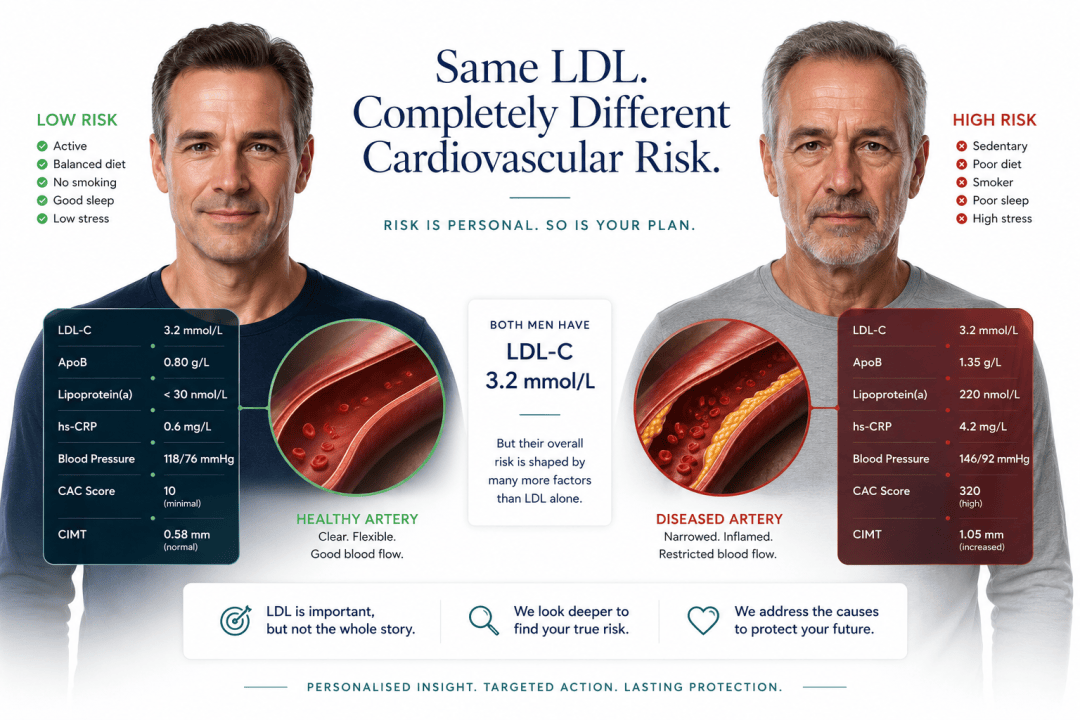
Why isn’t cholesterol enough?
LDL cholesterol matters. It is one piece of cardiovascular risk.
What I want to understand is the wider picture: particle burden, genetics, insulin resistance, inflammation, blood pressure, sleep, fitness, body composition and, where appropriate, whether plaque is already present in the coronary arteries.
That gives us a much more useful basis for deciding what needs to change.
What I’d like you to remember:
A cholesterol result is not the same thing as a cardiovascular risk assessment.
What do I look at first?
I start with the basics.
This includes:
-
blood pressure
-
family history
-
smoking
-
weight, waist circumference and body composition
-
exercise and cardiorespiratory fitness
-
sleep and possible obstructive sleep apnoea
-
HbA1c and glucose control
-
standard lipid profile
-
kidney and liver function
-
inflammatory markers
-
diet and alcohol intake
In many people, this already shows us where the main risk is coming from.
If the picture remains unclear, or cholesterol stays high despite meaningful lifestyle improvement, I look deeper.

ApoB – particle number matters
LDL cholesterol measures the amount of cholesterol being carried.
ApoB gives me a better idea of the number of atherogenic particles carrying it.
That distinction matters. Two people can have a similar LDL cholesterol but quite different ApoB levels.
For patients with persistent hypercholesterolaemia, metabolic dysfunction or an uncertain risk profile, ApoB can add useful information.

Lipoprotein(a) – inherited risk
Lp(a) is largely genetic.
It is one reason cardiovascular disease can run strongly in families, even when somebody has otherwise lived well.
Most people only need it checked once.
If it is elevated, I pay closer attention to the rest of the cardiovascular picture and to the factors we can modify.
Is there already plaque?
Sometimes the blood tests still leave the most important question unanswered.
Is there evidence of coronary artery disease already present?
This is where a coronary artery calcium scan can be very useful.
A CAC scan is a low-dose CT scan that measures calcified plaque within the coronary arteries.
I particularly consider it when:
-
cholesterol remains significantly elevated
-
ApoB or Lp(a) is high
-
there is a strong family history of premature cardiovascular disease
-
the decision about medication is uncertain
-
the overall risk picture remains unclear
A CAC scan does not replace good clinical assessment, but it can change how we interpret everything else.
A calcium score of zero and a high calcium score do not carry the same meaning, even when the cholesterol numbers look similar.

What happens once we understand the risk?
Then we treat the drivers.
For one person that may mean lowering ApoB.
For another, it may mean improving insulin sensitivity, visceral fat and blood pressure.
Someone else may need more attention to sleep apnoea, smoking, fitness or inherited Lp(a).
The treatment should follow the biology.
Metabolic health
Cardiovascular disease and insulin resistance often travel together.
A normal HbA1c does not always exclude early metabolic dysfunction.
Where appropriate, I may also look at fasting insulin, fasting glucose, triglycerides, waist circumference and body composition.
This helps identify risk earlier, before diabetes becomes established.

Inflammation and vascular health
Depending on the individual, I may also look at:
-
CRP
-
renal function
-
urine albumin-creatinine ratio
-
uric acid
-
homocysteine
-
thyroid function
For cardiovascular risk, I generally prefer CRP to be 1 mg/L or lower, while always interpreting it in the wider clinical context.

Nutrition
I generally favour a Mediterranean-style approach, adapted to the individual rather than imposed as a rigid diet.
The priorities are usually:
-
plenty of vegetables and plant diversity
-
adequate protein
-
extra virgin olive oil
-
nuts and seeds
-
legumes
-
oily fish
-
good fibre intake
-
fewer ultra-processed foods
-
less refined carbohydrate where appropriate
Where useful, I may also use soluble fibre, psyllium, plant sterols or a more structured Portfolio-style approach.
Body composition and fitness
I am more interested in body composition than weight alone.
The goals are to reduce visceral fat, preserve or build muscle and improve insulin sensitivity.
Exercise matters here.
Depending on the person, that may include walking, zone 2 exercise, resistance training and, where appropriate, higher-intensity work.
Cardiorespiratory fitness matters just as much as the number on the scales.
Blood pressure and sleep
Blood pressure remains one of the most important modifiable cardiovascular risk factors.
Home readings are often more useful than relying on an occasional clinic measurement.
Sleep deserves equal attention.
Obstructive sleep apnoea can contribute to hypertension, insulin resistance, arrhythmia and cardiovascular strain. If the history suggests it, I investigate it properly.
Supplements and nutraceuticals
Depending on the individual, this may include:
-
omega-3 fatty acids
-
magnesium
-
soluble fibre
-
psyllium
-
plant sterols
-
berberine
-
CoQ10
-
selected metabolic or mitochondrial support
They sit alongside the main treatment plan. They are not a substitute for proper cardiovascular assessment.
What about statins?
This is often where patients want a clearer answer.
I do not believe the decision should be based on one cholesterol number in isolation.
For some people, statins are clearly worthwhile. For others, the expected benefit may be smaller, they may not tolerate them, or they may prefer another approach.
Depending on the situation, alternatives or additional treatments may include:
-
ezetimibe
-
bempedoic acid
-
PCSK9-directed treatment
-
inclisiran
I prefer to make that decision in the context of the whole risk profile: LDL, ApoB, Lp(a), blood pressure, family history, metabolic health, coronary calcium and whether cardiovascular disease is already present.
It should be a shared clinical decision.

Is this the right next step for you?
If you have persistently high cholesterol, a strong family history of cardiovascular disease, elevated ApoB or Lp(a), or you are simply unsure what your results really mean, this programme is designed to give you a clearer picture.
The first step is to review your history, current results, risk factors and what has already been tried.
From there, we can decide whether further testing is likely to add useful information, whether a coronary calcium scan should be considered, and where the greatest opportunities are to reduce your risk.
The goal is not to make cardiovascular medicine more complicated.
It is to make the next decision clearer.
If you would like to explore whether this approach is suitable for you, please complete a New Patient Enquiry.